Launching in early-2026, the Lancet MedZero will serve as a one-stop global platform for
robustly evaluating the carbon footprint of healthcare at unprecedented scope and scale.
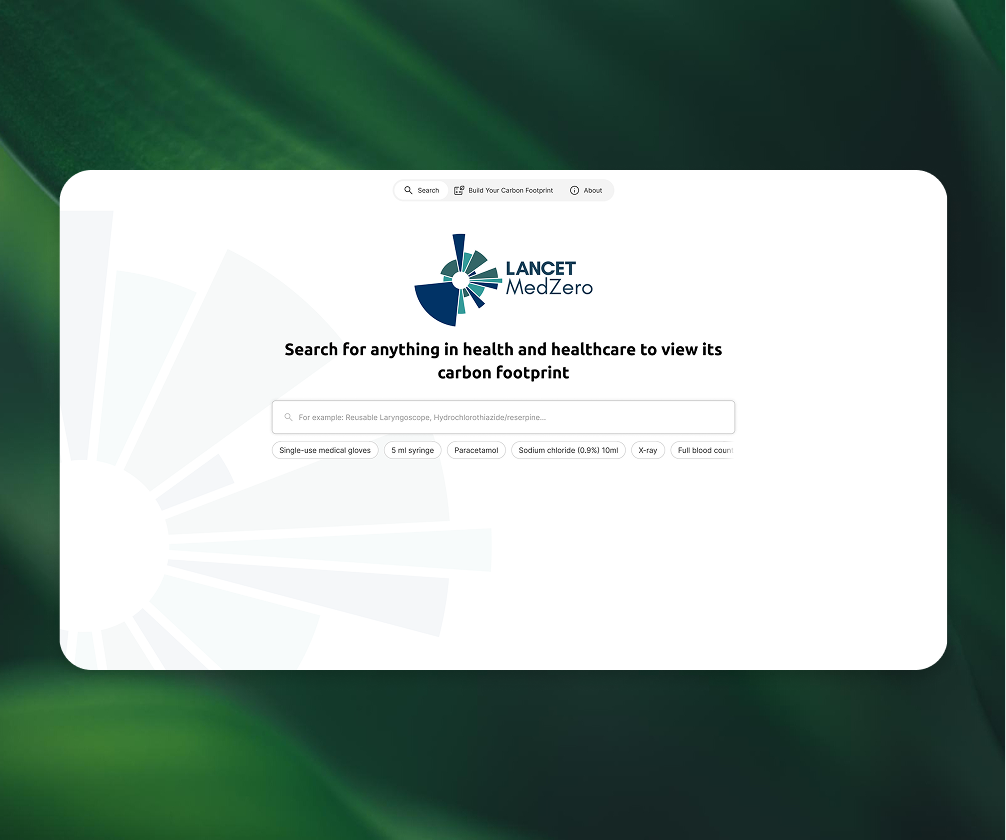
Designed for clinicians, procurement and sustainability professionals, and health policymakers, the
user-friendly interface will provide robust carbon data of every part of the clinical pathway, including medical
and surgical devices, pharmaceuticals, diagnostic services, and care pathways. Users will be able to adjust
underlying assumptions, allowing footprints to be tailored to specific clinical context.
The Lancet MedZero will provide the carbon impact data critical for integrating sustainability considerations
into health technology assessments, clinical guidelines, procurement practices, health system policymaking,
and ultimately, day to day clinical practice.
An undertaking of this scale and ambition can only succeed if it is truly collaborative,
working with the best expertise from across the world, and across every discipline. The Lancet MedZero is
embarking on a global consultation process, looking for input on:
LCA data gathering, including for medical products, pharmaceuticals, pathology
and imaging, travel, energy and other areas
Carbon footprinting methodologies, including process-based and alternate approaches including
parametric modelling and innovative approaches
Scientific standards and review, ensuring the analytics underpinning the platform are high
quality and clinically meaningful
Integration into health systems and clinical practice, including representation from
healthcare professionals, procurement and sustainability professionals, and policymakers
We're hosting a series of interactive webinars to co-create the foundations of the Lancet
MedZero, each held twice to capture different time zones. From scientific standards to real-world integration,
these sessions bring together experts and practitioners from across the health sector. Your insights will help
define the next generation of carbon analytics in healthcare.
27 Jan 2026, 5pm EST
(27 Jan, 2pm PST / 28 Jan, 6am SGT)
28 Jan 2026, 4pm SGT
(28 Jan, 8am GMT / 28 Jan, 7pm AEDT)
Topic 1: High-quality data, novel methodologies, and robust scientific standards
This session will take a deep dive into the technical backbone of the Lancet MedZero.
We'll explore potential data sources, methodological approaches, and the frameworks needed to ensure scientific
rigor across the platform. Participants are invited to contribute insights from their domains as we work
together to advance the evidence base behind carbon measurement in healthcare.
Topic 2: Embedding carbon analytics into health systems and clinical practice
This webinar will focus on how carbon analytics from the Lancet MedZero can be translated
into meaningful action across health systems. We’ll discuss practical use cases, integration into clinical
pathways, and strategies for enabling decision-makers and practitioners to apply these insights in everyday
workflows. Bring your experiences and challenges as we explore what effective implementation looks like in
real-world settings.
The Lancet is a world-leading general medical journal that publishes the best science
from the best scientists worldwide, providing an unparalleled global reach and impact on health.
Since Thomas Wakley founded The Lancet in 1823, it has strived to make science widely available so that
medicine can serve and transform society, and positively impact the lives of people. Their papers and
initiatives have made a crucial contribution to science and human health.
NUS
The National University of Singapore (NUS) is a leading global university in Asia
known
for its comprehensive research and diverse academic programmes. Within NUS is the NUS Yong Loo Lin School
of
Medicine, Singapore's first and largest medical school. The School is the oldest institution of higher
learning in the National University of Singapore and a founding institutional member of the National
University Health System. It is one of the leading medical schools in Asia and ranks 17th on the 2025
Times
Higher Education World University rankings and 18th on the 2025 QS World University Rankings for Medicine.
In 2023, NUS set up the Centre for Sustainable Medicine (CoSM), the first research centre in Asia and the
largest in the world dedicated to delivering real-world change by training future healthcare leaders and
equipping clinicians, industry, and health policymakers with the tools and evidence needed to respond at
pace to climate change.
Northeastern University
Founded in 1898, Northeastern University is renowned for their experiential learning
model, high-impact research, deep partnerships, and worldwide reach. They have pursued innovative ways of
teaching and research that place a premium on experience and engagement with the world. The University's
signature approach erases traditional boundaries, empowering not only students, but faculty, alumni,
partners, and innovators to solve problems and pursue impact.
University of Melbourne
The University of Melbourne is Australia's leading university, with a distinctive
Melbourne experience that helps graduates become well-rounded, thoughtful and skilled professionals -
making
a
positive impact across the globe. The University's research contributes to solving social, economic and
environmental challenges the world is facing today and into the future. They strive to be tightly
connected
with communities, at home and abroad, which only enriches learning, teaching, and research.
NIES
The National Institute for Environmental Studies (NIES) strives to contribute to
society
through research that fosters and protects a healthy environment for present and future generations.
Keenly aware of our individual and collective responsibilities, NIES pursues high level research based on
a
firm understanding of the interaction between nature, society and life on our planet.
HITAP
The Health Intervention and Technology Assessment Program (HITAP) Foundation
is an
independent research institute with expertise in health technology assessment (HTA). HTA provides evidence
to
inform the design of Thailand's universal health coverage (UHC) benefit package, including medicines,
vaccines, health services, programs, and procedures.
HITAP's research evaluates the impacts of health technologies, interventions, and policies across health,
economic, social, and environmental dimensions. The findings support evidence-informed policymaking in
close
collaboration with key national authorities, such as the National Health Security Office (NHSO) and the
Ministry of Public Health in Thailand.




 We need your help!